Home › AI› Singapore Data Centre Operators Turn to AI Cooling to Ease Grid Strain
AISingapore Data Centre Operators Turn to AI Cooling to Ease Grid Strain
Jordan Ellis
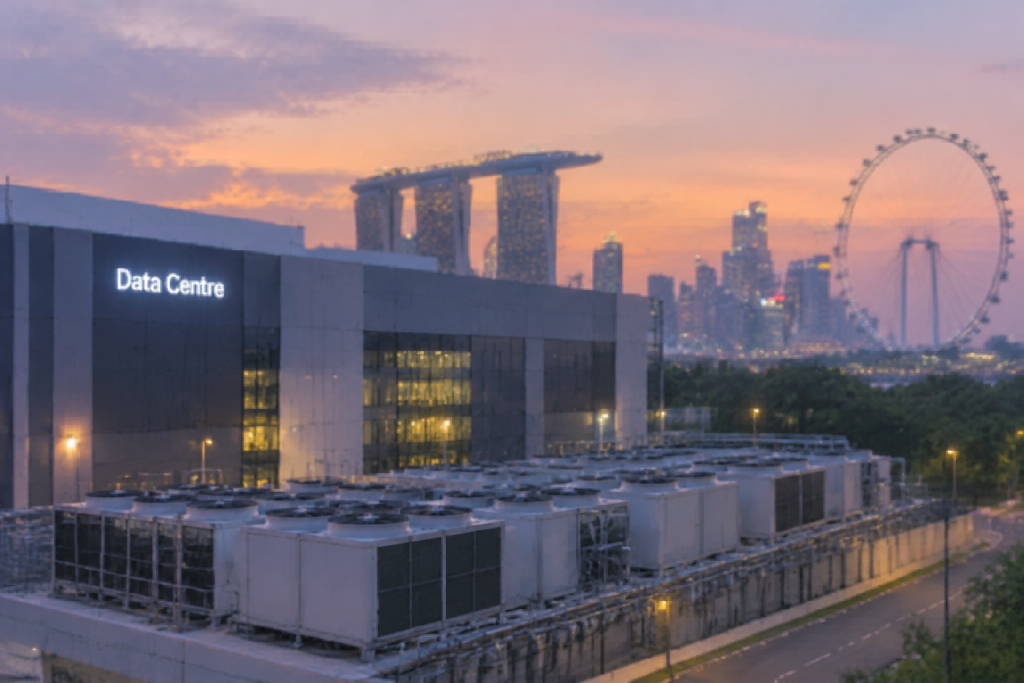
A Singapore data centre operator is rolling out AI-driven cooling controls to cut electricity demand as the city-state's grid strains under growing compute workloads, adjusting chilled-water and airflow settings in real time rather than at fixed setpoints.
A Singapore data centre operator has begun deploying AI-driven cooling controls across its facilities, part of an effort to reduce electricity demand as the city-state’s grid comes under pressure from growing compute workloads. The system adjusts chilled-water and airflow settings in real time based on server load and ambient conditions, rather than running cooling at fixed setpoints.
Engineers on site describe the change as gradual rather than dramatic
The deployment reflects a broader squeeze in Singapore, where land and power are scarce and data centre capacity has been tightly managed by regulators since a moratorium on new builds was lifted under stricter efficiency conditions. Operators are now competing less on floor space than on how much compute they can deliver per megawatt, and cooling is the single largest lever. Industry estimates put cooling at a substantial share of a typical facility’s power draw, and even modest reductions compound across a campus.
Sensors feed temperature, humidity and load data into models that recommend or automatically apply adjustments, with human oversight during early phases. The approach borrows from techniques already used in semiconductor fabrication plants and large logistics warehouses, where tight environmental control is paired with continuous optimisation. In Singapore’s humid climate, the margin for error is narrow: too little cooling risks hardware faults, while over-cooling wastes power that the grid can ill afford.
The operator’s engineers have found that the hardest part is not the modelling but the change management. Facility teams accustomed to fixed setpoints and conservative safety margins need convincing that a model can be trusted to vary chilled-water temperatures without putting servers at risk. Early phases therefore keep a human in the loop, with the AI recommending adjustments that operators approve before they are applied. Over time, the aim is to let the system act automatically within guardrails, while logging every intervention so that performance can be audited against baseline power data.
That caution is warranted. Data centre cooling is not a single system but a chain of chillers, pumps, cooling towers and air handlers, each with its own inertia and failure modes. A model that optimises one component in isolation can push another out of its efficient range. The operator says it is tuning the controls hall by hall rather than campus-wide, and reviewing results against baseline power data before extending them. The piecemeal approach slows the rollout but limits the risk of a bad setpoint cascading through a live facility.
Analysts covering the sector noted that AI-assisted cooling is becoming a standard part of the pitch
A spokesperson for the operator said the goal is to squeeze more useful compute out of every megawatt without compromising reliability, and that the AI controls are being rolled out building by building with performance reviewed against baseline power data. The spokesperson added that the company is working with utility and regulatory stakeholders on how efficiency gains are measured and reported, and that early results have been encouraging but that full-year data will be needed before drawing firm conclusions.
Analysts covering the sector noted that AI-assisted cooling is becoming a standard part of the pitch for new capacity in Singapore, though they cautioned that savings vary widely with facility age and design. Older halls with less granular sensing and older chillers tend to see smaller gains, while newer builds designed around variable setpoints can capture more. That variability matters for regulators, who are wary of claims that cannot be compared across operators. A common measurement framework would let efficiency gains be verified rather than asserted, and the operator’s engagement with utility and regulatory stakeholders on reporting suggests that framework is still being worked out.
The operator plans to extend the controls to additional halls over the coming quarters and to publish aggregated efficiency figures as part of its sustainability reporting. Regulators are expected to keep a close watch on whether such tools translate into measurable grid relief, since future data centre approvals in Singapore are likely to hinge on demonstrated efficiency rather than stated intentions. For now, the story is one of incremental engineering: fewer kilowatts wasted on cooling, more headroom for the AI workloads that prompted the problem in the first place.
Read next

AI
Banks Rethink Model Hosting as AI Workloads Strain On-Premise Infrastructure
Financial institutions are shifting from on-premise AI model hosting to hybrid architectures, balancing latency, data sovereignty, and cost

AI
Singapore Stablecoin Rules Draw AI Compliance Tools as Issuers Rework Controls
Meridian Ledger releases an AI monitoring layer for stablecoin issuers in Singapore, tracking reserve movements and flagging deviations

Hardware
Data Centre Operators Confront Power Crunch as AI Loads Surge in Singapore
Singapore's data centre operators are turning to liquid cooling and on-site generation as AI workloads push power density